


Who has the right of way in a Grand Junction pedestrian accident?In a Grand Junction pedestrian accident, the right of way depends on where the person was crossing. Drivers must yield to people in marked or unmarked crosswalks. Pedestrians who cross outside of crosswalks must yield to vehicles.
But even when a pedestrian was in the wrong place, the driver still has a legal duty to use care to avoid hitting them.
Colorado’s pedestrian right-of-way statute and comparative fault rules determine a Grand Junction pedestrian accident claim by allocating fault between the driver and the pedestrian based on each party’s conduct and the location of the crossing.
The statutes set out specific duties for both sides, and the comparative fault rule under C.R.S. § 13-21-111 reduces the pedestrian’s recovery in proportion to their share of fault and bars recovery entirely at 50 percent or more.
A Grand Junction pedestrian accident lawyer works to allocate fault correctly under the statutory framework rather than letting the driver’s insurance carrier dictate the percentages.
Most consumer guides treat Colorado pedestrian law as a simple binary: either the pedestrian was in a crosswalk and the driver is at fault, or the pedestrian was outside a crosswalk and the case is lost.
The actual law is more nuanced than that. Drivers retain a duty of due care under C.R.S. § 42-4-807 regardless of where the pedestrian was crossing, and the comparative fault analysis hinges on what both parties were doing at the moment of impact.
The interaction among the right-of-way rules, the due care obligation, and the 50 percent comparative fault bar determines whether a pedestrian case wins, loses, or settles for a fraction of full value.
What’s at Stake
- Drivers must yield to pedestrians in marked or unmarked crosswalks: The duty applies whether traffic signals are present or not.
- Pedestrians crossing outside crosswalks must yield to vehicles: But this rule does not eliminate the driver’s separate duty of due care.
- The driver’s due care obligation always applies: Under C.R.S. § 42-4-807, drivers must use reasonable care to avoid hitting pedestrians regardless of where they are.
- The 50 percent rule decides the case: A pedestrian found 50 percent or more at fault recovers nothing under Colorado’s modified comparative fault statute.
- Children and incapacitated pedestrians trigger heightened driver duties: The statutory framework requires extra precaution when drivers see kids or vulnerable adults on the roadway.
How Does Colorado’s Crosswalk Right-of-Way Rule Actually Work?

Colorado’s crosswalk right-of-way rule under C.R.S. § 42-4-802 requires drivers to yield to pedestrians crossing in marked or unmarked crosswalks at intersections when traffic control signals are not in operation. The driver must slow down or stop to allow the crossing. The rule is the foundation of pedestrian protection on Colorado roadways, but several specific provisions affect how it applies in real cases.
Marked Versus Unmarked Crosswalks
Most people think of crosswalks as the painted lines across a street. Colorado law also recognizes unmarked crosswalks, which exist at intersections where two roads meet even without painted lines. The unmarked crosswalk is generally the area where a sidewalk on one side would extend across the road to meet a sidewalk on the other side. Drivers must yield to pedestrians in unmarked crosswalks the same way they must yield in marked ones.
When the Signal Is Operating
When traffic control signals are in place and functioning, the right-of-way is controlled by the walk and don’t-walk signals rather than by the basic yield rule. A pedestrian crossing on a walk signal has full right-of-way. A pedestrian crossing on a steady don’t-walk signal does not. The flashing don’t-walk indication has its own rule: pedestrians who have started crossing during the walk signal must continue to a safety island or sidewalk, and drivers must yield to them.
Approaching Pedestrians and the Immediate Danger Provision
The statute requires drivers to yield not only to pedestrians who are already in the driver’s half of the roadway but also to pedestrians approaching closely enough from the other half to be in danger. The provision recognizes that pedestrians are vulnerable and need protection while crossing, not just while in front of a specific vehicle.
The Anti-Pass Rule
When a vehicle stops at a crosswalk to let a pedestrian cross, drivers approaching from behind cannot pass the stopped vehicle. The provision prevents the common pattern of one driver yielding while a second driver in the next lane fails to see the pedestrian and hits them.
How Comparative Fault Decides the Case
Comparative fault under C.R.S. § 13-21-111 decides the case by reducing the pedestrian’s recovery in proportion to their share of fault and barring recovery entirely when the share reaches 50 percent. The allocation depends on the specific facts of the case, but recurring patterns emerge in Colorado pedestrian cases.
| Scenario | Driver Fault (%) | Pedestrian Fault (%) | Outlook |
|---|---|---|---|
| Pedestrian in marked crosswalk, signal walk indication | 90-100% | 0-10% | Full or near-full recovery |
| Pedestrian in unmarked crosswalk at unsignalized intersection | 70-90% | 10-30% | Significant recovery with documentation |
| Pedestrian crossing mid-block in clear daylight, driver speeding or distracted | 60-80% | 20-40% | Reduced but viable recovery |
| Pedestrian crossing mid-block at night in dark clothing, driver at reasonable speed | 30-50% | 50-70% | Marginal; likely barred |
| Pedestrian darts from between parked cars, driver had no warning | 10-30% | 70-90% | Recovery barred at 50%+ |
| Child or visibly impaired person, the driver had time to react | 80-100% | 0-20% | Strong recovery |
The percentages in the table are illustrative, not formulas. Actual fault allocation depends on specific facts, including the driver’s speed, attention, sobriety, and reaction time, along with the pedestrian’s conspicuity, location, behavior, and any contributing factors like alcohol or distraction. The insurance carrier’s incentive is always to push the pedestrian’s percentage higher; the case work focuses on documenting the driver’s actual conduct in detail.
How Grand Junction’s Local Crossing Patterns Affect Your Claim
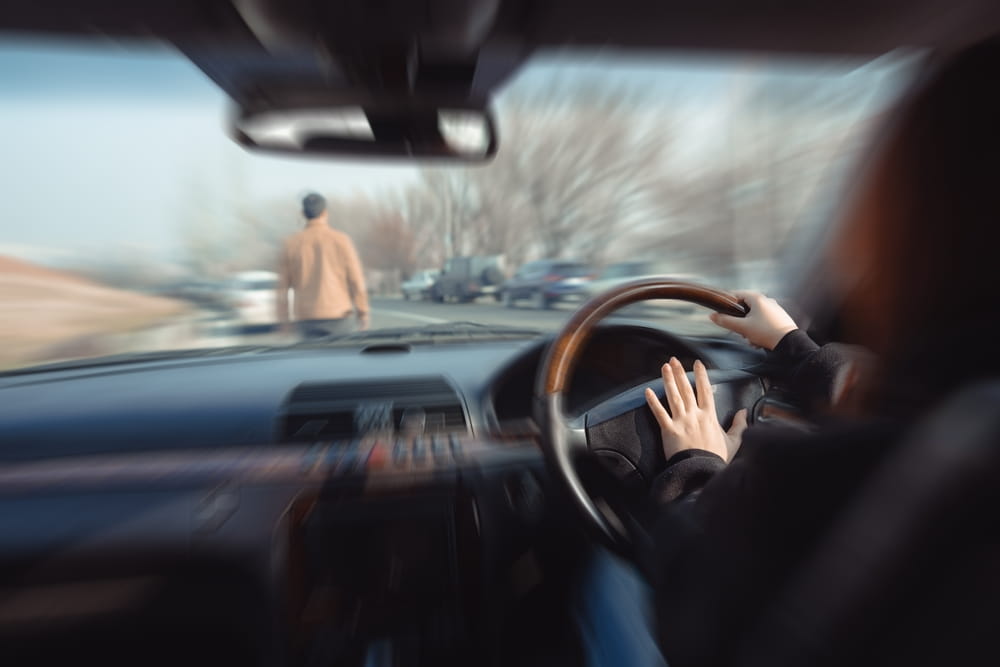
Grand Junction’s specific roadway geography produces recurring crash patterns that affect how pedestrian cases get evaluated. Local conditions matter because the comparative fault analysis is fact-specific, and the same crossing in Grand Junction may produce a different fault allocation than the same crossing in Denver.
- Downtown Main Street crossings: Heavy pedestrian traffic during evening hours, mixed with vehicle traffic from the restaurant corridor, produces crashes where driver inattention and impaired driving are common factors. Mesa County juries are generally familiar with the downtown walking environment and may evaluate these cases differently than crashes in less walkable areas.
- North Avenue and the Colorado Mesa University area: Student crossings between campus and off-campus housing happen at mid-block locations and during low-light conditions. Driver speed and pedestrian visibility become the central contested facts in these cases.
- Patterson Road and Horizon Drive arterials: High-speed arterials with limited pedestrian infrastructure produce crashes involving people moving between businesses, hotels, and parking lots. The roadway design factors into the comparative fault analysis when pedestrian routes were not adequately provided.
- Parking lot incidents at commercial properties: Pedestrians struck by vehicles backing out of parking spaces involve a different legal framework where the property owner’s design choices may bear partial responsibility alongside the driver.
- Crashes near schools and elderly housing: Crashes near elementary schools, retirement communities, and assisted living facilities trigger the heightened due care provisions of § 42-4-807, which can shift fault percentages substantially toward the driver.
- Crashes during winter conditions: Snow, ice, and limited daylight in winter months affect both driver visibility and pedestrian conspicuity. The conditions can cut either way in the fault analysis depending on what each party did in response to the visible conditions.
The pattern of crashes in Mesa County does not determine the outcome of any individual case, but it shapes how insurance carriers value claims and how juries evaluate the conduct of both sides.
Frequently Asked Questions
What if the driver who hit me said I came out of nowhere?
The “came out of nowhere” defense is the most common explanation drivers give in pedestrian cases, and it rarely matches what actually happened. Investigation typically establishes that the driver had visible warning, was distracted, or was not looking in the direction the pedestrian came from. Witnesses, video evidence, and sight-line analysis frequently undermine the “sudden appearance” framing.
Does it matter if I was wearing dark clothing or had been drinking?
Yes, both factors can affect the comparative fault analysis. Dark clothing in low-light conditions can shift some fault to the pedestrian, particularly in cases where conspicuity was a real issue. Pedestrian alcohol consumption can also factor in if it affected the pedestrian’s judgment or behavior. Neither factor by itself bars recovery, but both feed into the percentage allocation.
What is the statute of limitations for a Colorado pedestrian accident lawsuit?
Three years from the date of the crash under C.R.S. § 13-80-101, under the motor vehicle exception to Colorado’s general two-year personal injury limit. Evidence that decides these cases, including surveillance footage, witness recall, and the driver’s vehicle data, fades long before the three-year deadline.
Does my own auto insurance pay if I was hit as a pedestrian?
Possibly, depending on your policy. Uninsured motorist coverage on your auto policy typically extends to you as a pedestrian if you are struck by an uninsured driver or in a hit-and-run incident. Medical payments coverage on your policy may also pay for medical bills regardless of fault. According to the Centers for Disease Control and Prevention, hit-and-run incidents are disproportionately represented in pedestrian fatality data nationally, making uninsured motorist coverage particularly relevant.
Can I recover if I was crossing on a flashing don’t-walk signal?
Possibly, depending on whether you had started crossing during the walk indication. C.R.S. § 42-4-802 specifically protects pedestrians who began their crossing during a walk signal and were still in the roadway when the signal changed. Drivers are required to yield to those pedestrians completing their crossing. A pedestrian who started during the flashing don’t-walk has a weaker position, but the driver’s due care duty still applies.

The Fault Percentage Is What the Case Comes Down To
A Grand Junction pedestrian accident case rarely turns on whether the driver caused the crash or whether the pedestrian was perfect in their crossing behavior. It almost always turns on the fault percentage that gets assigned to each side. The insurance carrier will work to push the pedestrian’s percentage as close to 50 as possible because crossing that line eliminates the claim entirely. The pedestrian’s interests run in the opposite direction.
The factual record built in the first weeks after the crash decides where the percentage ultimately lands. Police reports, witness statements, video evidence, vehicle data, and the medical documentation of the injuries all factor into the analysis.
Pedestrians who treat the case as straightforward because they “had the right of way” or because the driver “obviously caused it” frequently end up disappointed when the carrier’s fault percentages arrive.
What would your case look like if the fault percentages were established by an attorney working the evidence rather than by the insurance carrier setting the narrative? If you were hit while crossing in Grand Junction, contact the injury attorneys at Slingshot Law to discuss the details of your case. Call (800) 488-7840.