


What is Colorado’s 50% Rule in motorcycle accident cases?Colorado’s 50% rule means a motorcycle rider who is found 50% or more at fault for a crash cannot recover any money damages. If the rider’s share of fault is less than 50%, the damages award is reduced by the rider’s percentage.
Insurance companies use this rule aggressively against motorcyclists because pushing the rider’s fault percentage above 49% wipes out the entire claim.
Colorado’s 50% rule can destroy a Grand Junction motorcycle accident claim by barring recovery entirely when an insurance company successfully pushes the rider’s share of fault to 50% or more.
Under C.R.S. § 13-21-111, Colorado follows a modified comparative negligence system, under which the rider must be found less at fault than the at-fault driver to recover any compensation. A motorcycle accident lawyer fights the comparative fault arguments insurance companies use to push that percentage past the bar.
Riders who understand how the comparative fault attack actually works are in a substantially better position than riders who think their claim is safe because the police report says the other driver was at fault.
Why is This Important?
- The bar applies at exactly 50%: A rider found 50% or more at fault receives nothing. The threshold is precise, and insurers deliberately push toward it.
- The statutory language matters: The rider’s negligence must be less than the defendant’s to allow recovery. Equal fault means no recovery.
- Helmet non-use can reduce damages: Adults are not required to wear helmets in Colorado, but failure to wear one can support a comparative fault argument on head injury damages specifically.
- Eye protection violations carry weight: All riders must wear protective eyewear unless the motorcycle has a windscreen, and violations support negligence arguments.
- Lane filtering rules changed in 2024: Lane filtering between stopped vehicles became legal on August 7, 2024, with specific conditions that determine whether a maneuver was lawful.
What Does Colorado’s Modified Comparative Negligence Rule Actually Say?
Colorado’s modified comparative negligence rule under C.R.S. § 13-21-111 bars recovery when the injured party’s negligence is “as great as” the defendant’s negligence. In a two-party case, this translates to the 50% bar. A rider at 49% fault recovers reduced damages. A rider at 50% fault recovers nothing.
The statute’s exact language is precise: contributory negligence does not bar recovery “if such negligence was not as great as the negligence of the person against whom recovery is sought.” The phrase “not as great as” means less than. A rider who is equally at fault has negligence that is “as great as” the defendant’s, and the bar applies.
| Rider’s Fault Percentage | Recovery Outcome | Example on a $100,000 Verdict |
|---|---|---|
| 0% | Full recovery | $100,000 |
| 25% | Reduced by 25% | $75,000 |
| 49% | Reduced by 49% | $51,000 |
| 50% | Barred completely | $0 |
| 75% | Barred completely | $0 |
The dollar value of a single percentage point near the bar is significant. A rider at 49% fault on a $200,000 case receives $102,000. A rider at 50% receives nothing. The argument over that single percentage point is the most contested part of many motorcycle claims.
Why Are Motorcycle Riders Especially Vulnerable to Comparative Fault Attacks?
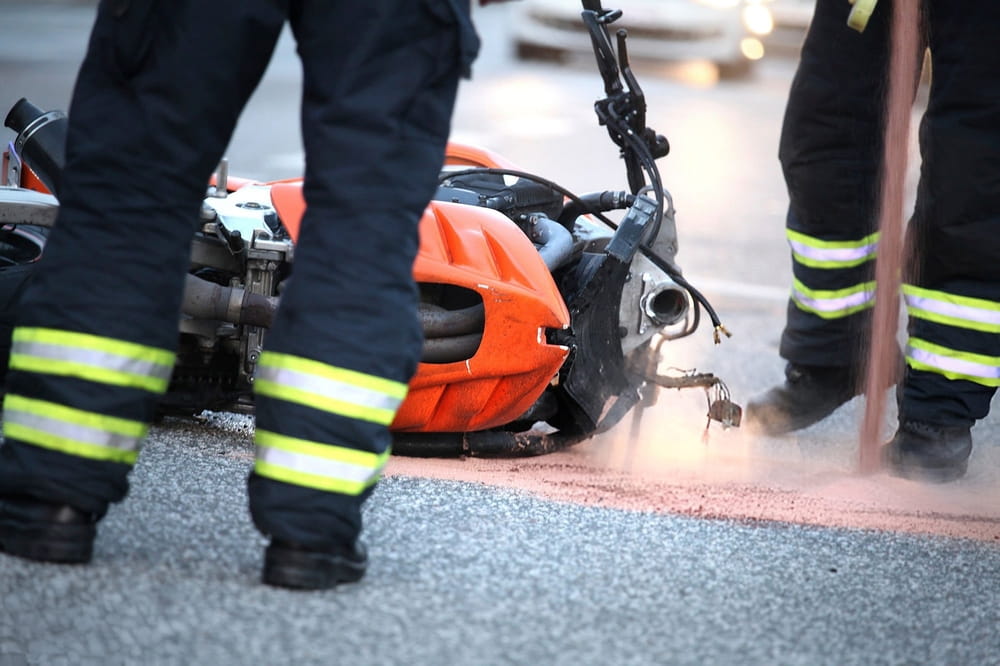
Motorcycle riders are especially vulnerable to comparative fault attacks because juries carry preconceptions about riders that drivers in passenger vehicles do not face. Insurance adjusters know this and structure their negotiation strategy around the assumption that a Mesa County jury will be receptive to the argument that the rider did something reckless.
- The “didn’t see you” left-turn defense: Left-turn crashes are the most common type of fatal motorcycle accident according to the National Highway Traffic Safety Administration. The standard defense in these cases is that the rider was traveling too fast for the driver to see in time. Speed becomes the comparative fault wedge.
- Speed perception bias: Motorcycles often appear to be traveling faster than they actually are because of how the rider’s body sits relative to the vehicle. Witnesses and even the riders themselves frequently estimate speeds higher than what accident reconstruction reveals.
- Helmet non-use arguments: Although Colorado law does not require adult riders to wear helmets, insurers raise the helmet decision to influence jurors who associate not wearing a helmet with recklessness. The argument is technically about damages, not liability, but the effect on overall fault perception is broader.
- Eye protection violations: Under C.R.S. § 42-4-1502, all riders must wear protective eyewear unless the motorcycle has a windscreen. A rider without compliant eyewear opens an additional comparative fault angle that has nothing to do with the underlying crash.
- Lane filtering compliance: Lane filtering became legal in Colorado on August 7, 2024, but only under specific conditions. Filtering when traffic is moving, exceeding 15 mph, or filtering between adjacent lanes that are not both stopped all create comparative fault exposure under the new rules.
Each of these factors is the kind of argument a carrier raises not to win on its merits, but to push the rider’s percentage of fault closer to the bar.
What Does the New Colorado Lane Filtering Law Mean for Crash Claims?
Colorado’s new lane filtering law, effective August 7, 2024, allows motorcycles to pass between stopped vehicles under specific conditions. The law does not legalize lane splitting between moving traffic, which remains a separate practice that is still illegal in Colorado.
Under Senate Bill 24-079, filtering is legal when all of the following conditions are met:
- All relevant traffic is stopped: Both the rider’s lane and adjacent lanes traveling in the same direction must be at a complete stop. Slow-moving traffic does not count.
- The motorcycle travels no more than 15 mph: Speed above this threshold while filtering disqualifies the maneuver.
- The lane width allows safe passage: The lane must be wide enough to fit both the stopped vehicle and the motorcycle without entering an oncoming traffic lane.
- The rider passes safely and maintains control: A rider who loses control or fails to operate prudently during the maneuver loses the legal protection.
A motorcycle rider involved in a crash while filtering must satisfy each of these conditions to avoid a comparative fault argument based on the maneuver. The Colorado Department of Transportation is collecting data on the law’s effects through 2027, at which point the legislature will determine whether to extend or modify the rule. The law’s existence does not insulate riders from comparative fault analysis when the conditions were not met.
How Do Insurance Companies Build the 50% Argument Against Riders?
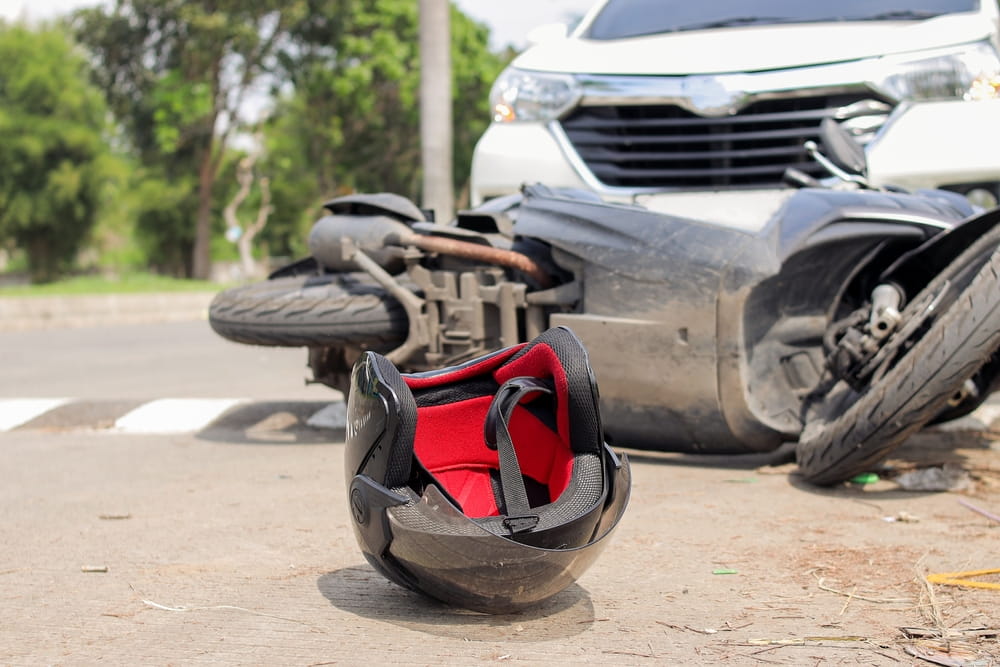
Insurance companies build the 50% argument against motorcycle riders through a combination of police report leverage, recorded statement opportunities, and the strategic framing of factors that may seem unrelated to the crash itself.
- Recorded statements early in the case: Adjusters request statements within days of the crash, before the rider has consulted counsel. Questions about speed, attention, gear choices, and prior riding experience are designed to produce admissions that support comparative fault.
- Police report exploitation: Police reports frequently encode the responding officer’s first impression of fault, which can favor whichever party was conscious at the scene. The narrative section of the report becomes the adjuster’s opening argument.
- Witness interviews framed against the rider: Witnesses who saw the crash from a distance often misperceive motorcycle speed and positioning. Adjusters interview witnesses with leading questions that produce statements favorable to the carrier’s theory.
- Independent medical examinations on head injuries: When head injuries are at issue and helmet use is contested, the carrier orders examinations from physicians who will testify that helmet use would have prevented the injuries.
- Reconstruction engineers retained early: Carriers retain accident reconstructionists who develop theories favorable to their insureds, frequently focusing on rider speed and visibility from the driver’s perspective.
Each of these tactics is part of a coordinated effort to push the rider’s fault percentage toward the 50% bar. The cases that defeat the strategy are the ones where the rider’s own preservation of evidence, refusal to give early recorded statements, and engagement of independent reconstruction work matches the carrier’s investment.
Frequently Asked Questions
Can I still recover damages if the police report blames me partially?
Yes, in many cases. A police report’s fault assignment is not binding on the courts or the insurance carriers, and it reflects the responding officer’s initial impression at a chaotic scene. Riders who appear to be at fault in the report frequently recover full or significantly reduced damages when independent investigation establishes what actually happened.
What is the difference between lane filtering and lane splitting in Colorado?
Lane filtering refers to passing between vehicles that are completely stopped, such as at a red light or in gridlock, and became legal on August 7, 2024 under specific conditions. Lane splitting refers to passing between vehicles that are moving, and remains illegal in Colorado. The distinction matters because a rider crashing while lane filtering under compliant conditions has a different fault posture than one crashing while lane splitting.
How long do I have to file a Colorado motorcycle accident lawsuit?
Three years from the date of the crash under C.R.S. § 13-80-101, which is the motor vehicle exception to Colorado’s general two-year personal injury limit. Evidence that supports the rider’s case, including skid marks, vehicle position photographs, and witness recall, degrades long before the statutory deadline.
Does the rider’s prior driving record affect the comparative fault analysis?
Generally, no, prior driving records are not admissible to prove fault in a current case. Insurance carriers sometimes raise prior incidents informally during negotiations, but the courts limit how this evidence can be used at trial. Specific exceptions exist for habitual reckless conduct or recent incidents that bear directly on the crash circumstances.
Will my own insurance company defend me if I’m accused of being more than 50% at fault?
Your own insurance carrier defends you when you are a defendant in a counterclaim. The carrier does not represent you in a claim against another party where comparative fault is raised as a defense to reduce your recovery. Those situations require independent representation focused on your interests as the injured party.

The Argument Over One Percentage Point Decides the Case
The single most consequential argument in a Grand Junction motorcycle accident claim is rarely the one about who caused the crash. The driver who turned left or pulled out from a side street is typically assigned the majority of the fault on the police report.
The argument that matters is the one over how much fault gets shifted to the rider, and whether the carrier can push the shift far enough to either reduce the recovery significantly or bar it entirely.
Riders who treat the comparative fault question as something an attorney can handle later usually find that the early decisions, including the recorded statement given to the adjuster in the first week and the documents signed without legal review, have already shaped the percentages assigned at the end of the case.
What would your recovery look like if your fault percentage were defended as carefully as the at-fault driver’s insurer is attacking it? If you were injured in a motorcycle crash in Grand Junction or anywhere on the Western Slope, contact the injury attorneys at Slingshot Law to discuss the details of your case. Call (800) 488-7840.