

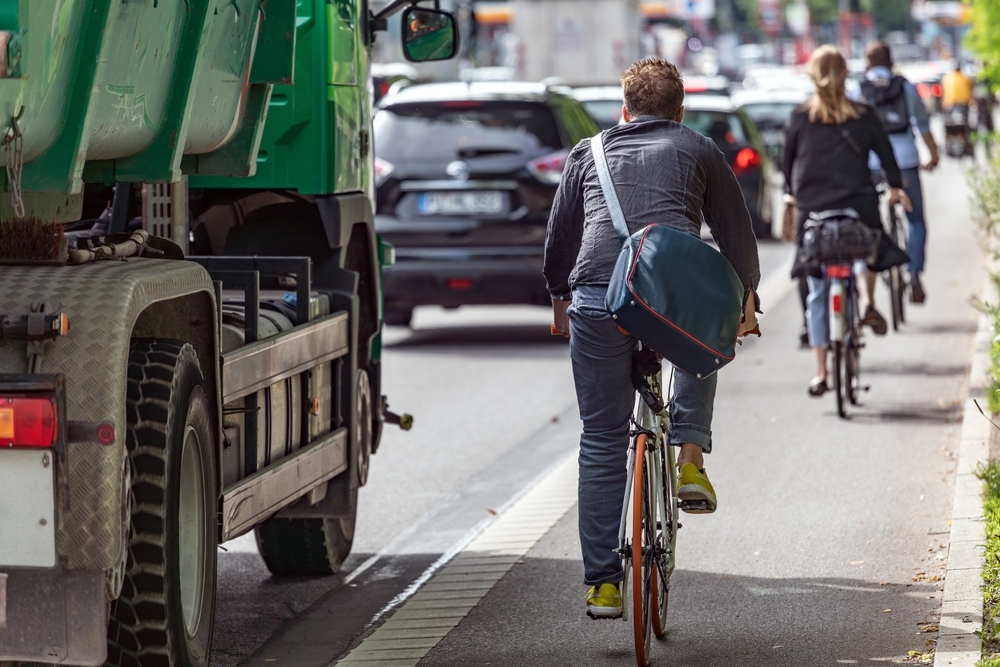
Most riders in Austin navigate downtown, the Lady Bird Lake trail, and neighborhood streets with only a rough sense of what Texas bicycle laws actually say. That gap matters more than it seems.
When a crash happens, the difference between “the cyclist was in the way” and “the cyclist had every right to be there” often comes down to a handful of specific statutes most drivers, and even some riders, have never read.
Key Takeaways
- Texas law treats a bicycle operator as having the same rights and duties as a driver of any other vehicle.
- Cyclists generally must ride near the right edge of the road, but several common exceptions allow taking the full lane.
- Austin’s local ordinance requires drivers to give cyclists at least three feet of space when passing, six feet for larger vehicles.
- Fault in a bike versus car crash follows the same comparative responsibility rules used in any other Texas crash.
- A cyclist’s own conduct can reduce, but does not automatically eliminate, their right to recover damages.
Bicycles Are Legally Vehicles in Texas
Under Texas Transportation Code Section 551.101, a person operating a bicycle has the rights and duties of a vehicle operator. That single line settles a debate that comes up constantly after a crash.
Cyclists are not treated as pedestrians, and they are not second-class users of the road. They have the same right to travel on public streets as any car or truck, with a narrow set of exceptions such as limited-access highways.
What the Vehicle Classification Costs Cyclists
This classification cuts both ways. It gives cyclists real legal standing after a crash, but it also means they are expected to follow the same traffic laws that apply to drivers, including stopping at red lights, signaling turns, and yielding where required.
Where Are Cyclists Required to Ride?
Texas Transportation Code Section 551.103 requires a cyclist moving slower than surrounding traffic to ride as near as practicable to the right curb or edge of the roadway. That phrase gives more flexibility than most people assume, and several exceptions let a rider take the full lane.
When a Cyclist Can Take the Full Lane
A cyclist can move away from the curb when passing another vehicle, preparing for a left turn, avoiding a hazard such as a pothole or an opening car door, or riding in an outside lane narrower than 14 feet with no designated bike lane. The statute separately covers any lane too narrow for a bicycle and a car to travel safely side by side.
On a one-way street with two or more marked lanes, a cyclist may ride near the left edge instead. Riders may travel two abreast, but only within a single lane and only if they do not impede the normal flow of traffic.
Bicycle Right-of-Way at Intersections and Crosswalks
Bicycle right-of-way in Texas generally mirrors the rules for any vehicle at an intersection, with one significant addition. The Lisa Torry Smith Act amended Transportation Code Section 544.007 and Section 552.003 to require drivers to stop and yield the right-of-way to pedestrians lawfully in an intersection or an adjacent crosswalk, rather than merely yield as the prior law required.
Where Cyclists Come Into the Crosswalk Rule
The same legislation added Section 545.428, which makes it a criminal offense to cause bodily injury with criminal negligence to a pedestrian or a person operating a bicycle within a crosswalk. That is where cyclists enter the picture, since the amended yield duty itself names pedestrians.
A criminal charge and a civil injury claim are separate matters. A cyclist can pursue compensation regardless of whether prosecutors file charges, which matters on streets near schools, parks, and the Ann and Roy Butler Hike-and-Bike Trail.
How Much Room Must a Driver Give a Cyclist?
Texas has no statewide law setting a specific passing distance for cyclists, which surprises a lot of people. Austin filled that gap locally with City Code Section 12-1-35, its vulnerable road user ordinance.
A passenger car or light truck must give at least three feet of clearance when passing. A truck other than a light truck, or a commercial motor vehicle, must give at least six feet. On a road with two or more marked lanes running the same direction, a driver may vacate the cyclist’s lane instead.
Why a Measured Distance Changes a Claim
The ordinance matters in a crash claim because a driver who passed closer than the required distance violated a specific, measurable standard rather than a vague notion of careless driving. That is much harder for an insurer to argue around.
Several other Texas cities, including Houston, Dallas, San Antonio, and Fort Worth, have adopted similar ordinances, though the exact language and distances vary.
What About Dooring?
Yes, Texas addresses this directly. Transportation Code Section 545.418 bars opening a vehicle door on the side available to moving traffic unless it can be opened in reasonable safety without interfering with traffic, and it also bars leaving that door open longer than necessary to load or unload a passenger.
Who Carries the Duty to Check
Dooring crashes happen most often on streets with on-street parking next to a bike lane, common throughout downtown Austin and older neighborhoods like Hyde Park and Bouldin Creek. Riding a reasonable distance from parked cars helps, but the legal duty to check before opening a door rests with the driver, not the cyclist passing by.
Who Is at Fault in a Bike vs. Car Crash?
Fault gets determined the same way it would in any Texas vehicle crash: through evidence, not assumptions about who was more vulnerable. Whether a bike versus car crash is the driver’s fault turns on which party violated a traffic law, a passing ordinance, or a basic duty of care, established through the police report, witness accounts, and sometimes surveillance or dashcam footage.
How Comparative Responsibility Applies
Texas follows a modified comparative responsibility rule under Civil Practice and Remedies Code Section 33.001. A cyclist can still recover damages even if partly at fault, as long as their share of the blame is 50 percent or less, with the recovery reduced by that percentage.
Insurers frequently argue a cyclist was not visible enough or was riding outside a bike lane unnecessarily. A claim that a cyclist “came out of nowhere” carries far less weight once it is measured against an actual passing distance, a documented right-of-way violation, or a lane positioning rule the cyclist was following correctly, and we build that comparison from the ordinance text up.
Riding in Austin’s Bike Lanes
A bike lane does not obligate a cyclist to use it. No Texas statute requires a rider to stay in a marked bike lane, a detail that frequently comes up in fault disputes after a crash.
Austin ordinance separately bars vehicles from driving or parking in a bike lane except briefly to make a turn, which is why a photograph of a car blocking the lane can matter months later.
Right Hooks and Turning Drivers
Electric bicycles have their own classification system under Transportation Code Chapter 551 and generally follow the same road rules as traditional bicycles depending on class.
On Austin’s protected and painted lanes, from South Congress to the Rainey Street corridor, the risk is a driver turning across the rider’s path. A right hook, where a driver turns right directly into a cyclist traveling in the bike lane, leaves almost no reaction time, which is why lane positioning and visibility carry so much weight in these disputes.
What to Do After a Bicycle Crash
A few steps matter more for cyclists than for a typical car crash. Call the police regardless of how minor it looks, because without a report there may be no official record that the crash happened at all.
Photograph the vehicle, the road, any skid marks or debris, and the bike itself. A bent frame or a damaged helmet is physical evidence that a written description cannot replace.
What to Keep After You Leave the Scene
See a doctor and keep the records, because a claim is built on documentation rather than recollection. Keep the damaged helmet and any torn gear as well, since insurers treat physical evidence differently from a description of it.
If the driver stops, get their information the same way you would in a car crash. Try to identify witnesses before they leave, since pedestrians and other cyclists on a busy trail often see more of a crash than the driver does.
FAQs: Texas Bicycle Laws
A few more questions come up often once someone starts looking into how these crashes actually get resolved.
Do cyclists have to use a bike lane if one is available?
No. Texas law does not require a cyclist to use an adjacent bike lane, and riders are permitted to use the full travel lane when road conditions call for it.
Can a cyclist be cited for riding without a helmet in Texas?
Texas has no statewide helmet law for adult cyclists, though some cities have local ordinances for riders under a certain age. Not wearing a helmet does not automatically make a cyclist at fault for a crash caused by a driver.
What are a cyclist’s rights after a Texas hit-and-run?
A cyclist hit by a driver who fled can generally pursue a claim through uninsured motorist coverage, the same as a hit-and-run between two cars. The two-year filing deadline under Civil Practice and Remedies Code Section 16.003 still applies, so getting a police report on file matters even when the driver was never identified.
Does riding at night without lights affect a claim?
Texas law requires specific lighting and reflectors after dark, and riding without them could factor into a comparative fault argument. It does not eliminate a claim outright, since the driver’s own conduct, such as speed, distraction, or failure to yield, is still evaluated independently.
Can a cyclist sue a driver even if no citation was issued?
Yes. A police citation is not required to pursue a personal injury claim, since fault in a civil case is evaluated separately from any criminal or traffic charge.
Talk to an Austin Bicycle Accident Attorney
 If you were hurt while riding in Austin, we can sort out which statutes and local ordinances apply to your crash at Slingshot Law – Injury Attorneys, and what that means for your claim. Bike crashes turn on details most people would not think to document, and the passing ordinance is usually the first thing we go looking for.
Call (800) 488-7840 to talk through what happened. This is for informational purposes only and is not legal advice.